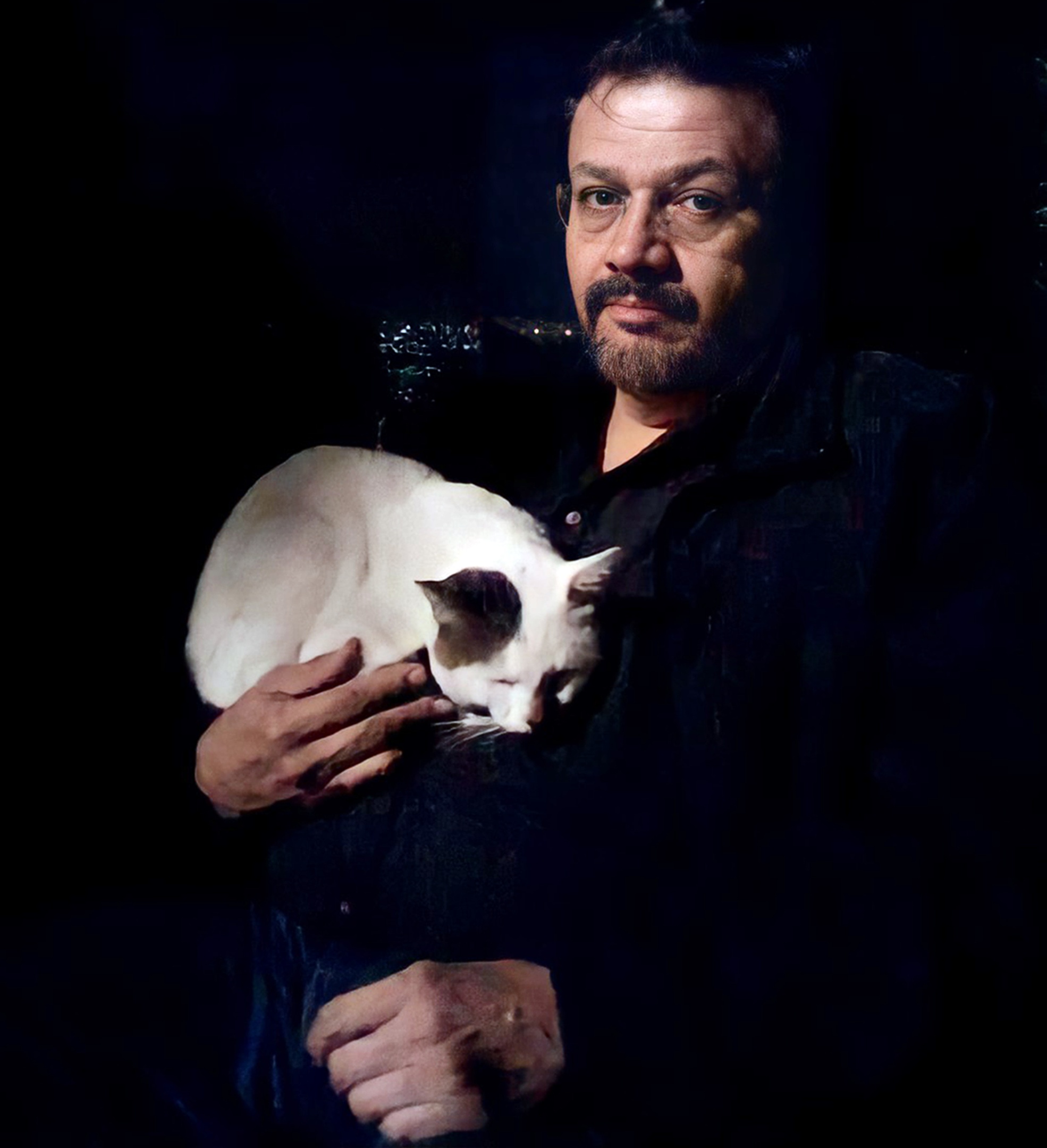
SOLO EXHIBITION. CAFÉTÉ, VERACRUZ, MEXICO, MAY 2025
Geografías del deseo
(Geographies of Desire)
PAINTINGS BY VICTOR ORTEGA


SOLO EXHIBITION. FORO BOCA, VERACRUZ, MEXICO, JULY 2023
IMÁGENES DEL ANTROPOCENO
Images of the Anthropocene refers to the sixth mass extinction of living beings, which is looming due to human impact on nature. Most of the animals depicted here are threatened with extinction; of one of them, only two specimens remain: the North African white rhinoceros. The technique used to create these works involves drawing with sodium hypochlorite (chlorine) on a dyed surface, which can be black or any other color. The chemical action of this substance bleaches the affected surface, and the image emerges.
“A few years ago,” Victor Ortega explains, “while watching a documentary about the Catalan painter Miquel Barceló, I saw some very interesting monochromatic drawings, which, according to the painter, were made with bleach. With that little bit of information, I started investigating on my own and obtained the results you can see here.”


SOLO EXHIBITION. UNIVERSITY MUSEUM OF CONTEMPORARY ART (MUAC)
CDMX, SEPTEMBER 4, 2010
PARTITURA PICTOGRÁFICA
(PICTOGRAPHIC SCORE)
Sound artwork presented in the context of the exhibition Translations and Synesthesias
Victor Ortega's Pictographic Score
Victor Ortega's pictographic score serves as a generative project. This score is composed of 52 graphic signs; musicians Pablo Salas, Salvador Amézquita, and Ernesto Soria will perform it with traditional musical instruments: saxophone, piano, and bass. The interpretation of the sound piece will depend on the hermeneutic processes induced by the visual signs. The word "interpret" here takes on the meaning given to it by Gadamer: "The important thing is that all interpretation does not point toward an objective, but only in a direction, that is, toward an open space that can be filled in diverse ways."*
The aim is to generate a synesthetic process between visual and sonic language. Translating the visual image into sound is a process of synesthetic translation that requires enormous creative flexibility from the performers. They must set aside the coded language they know and master from traditional musical notation and venture into an experience that is both sensory and rational. The piece aims to spark reflection on the processes of signification and meaning-making in the visual and the auditory, and explores the boundaries of the symbolic and iconic nature of the sign.
* Hans-Georg Gadamer, Aesthetics and Hermeneutics, Ed. Tecnos, Spain, 1998, p. 75.
Synesthesia is a sensory phenomenon in which stimulation of one sense produces an automatic response in another. Through this phenomenon, people can hear colors, see sounds, or assign a taste to a particular texture. Kandinsky describes one of his synesthetic experiences after listening to a work by Wagner: “The violins, the double basses, and especially the wind instruments then personified for me all the power of the twilight hours. Mentally, I saw all my colors; I had them before my eyes.”* This project can be interpreted as an exploration of the sonority of the graphic and the plasticity of sound, as well as the tactile translations that can be made of these elements. In this sense, it is a translation, not only in the spatial sense of the term, but also in the psychological and conceptual ones. The title, Translations and Synesthesias, also alludes to two concepts with which both words share a synonymous relationship: translation and metaphor.
This work can also be read as a tribute to Wassily Kandinsky, whose obsession with finding music through painting led him, a hundred years ago, to the invention of what we now call abstract art.
Production Team
Gerardo Marván/ Axel Alviso/ Carlos Viñamata/ Guadalupe Mendoza/ Ricardo Jiménez/ Magdalena Báez/ Mariana Ortega/ Carolina Sánchez/ Arturo Ramírez/ Miguel Ángel Flores/ Stephanie Chiquini/ Sofía Corral/ Donato Domínguez/ Alejandra Collado/ Carmen Llaguno/ Claudia Meléndez/ Carlos Basurto/ Edgar Guzmán/ Christian Arcos.


SOLO EXHIBITION. JUAN RULFO CULTURAL CENTER ,MEXICO CITY, FROM OCTOBER 30 TO NOVEMBER 23, 2008
UMBRALES IMAGINARIOS
(IMAGINARY THRESHOLDS)
Sculptural works and projects for walkable monumental sculpture
Nine small and medium-sized sculptures will be presented at the Juan Rulfo Cultural Center. Although the largest measures around 1.60 meters, their creator designed them to be built at least 8 meters tall. These are walkable sculpture projects that—as Victor Ortega explains—"were conceived for placement in public spaces and at a scale that allows people to move through them, both inside and out."
This is not a conventional sculpture exhibition. The pieces are accompanied by photographic montages and etchings showing them installed in various public spaces in Mexico City, simulating the dimensions to which they aspire to be built. The sculptor intends for this to provoke in the viewer "an imaginative exercise that allows them to feel small enough to walk through and penetrate them. Provoking this creative act is the function of the two-dimensional images that, through technological devices, allow some of these works to occupy monumental spaces in diverse urban locations."
For Ortega, public sculpture should be designed to improve the lives of those who will have to live with it for long periods, sometimes spanning a lifetime. Therefore, it should be playfully and joyfully integrated into the space that belongs to everyone and be malleable enough to change with the action of light at different times of day and in different seasons, as well as when viewed from different angles.
Regarding the costs of carrying out one of these projects, the artist (who is also a full-time professor and researcher at UAM-X) told us that it would be relatively inexpensive. If a public (or even private) institution were interested in undertaking it, they would only have to pay the construction costs. He would not charge anything, provided the work was placed in a public space, without any access restrictions, such as a park, plaza, school, or public building.
So, would you be willing to give away your work?
It's not a gift. “I am a professor at a higher education institution, and this work is part of my work as a researcher and educator—at least, that’s how I see it,” he concluded.
The exhibition, curated by Patricia Henríquez, will open on October 30 at 7:30 p.m. at the Juan Rulfo Cultural Center, located at Campana 59, Colonia Insurgentes Mixcoac, and will run until November 23. Admission to the opening and the exhibition is free.


